What is reverse osmosis?” is a question asked by many factory, farm, and hotel owners when they face high salinity, changing water quality, or water that is unsuitable for its intended use.
Choosing an RO unit or plant at random is not enough. System success depends on water analysis, determining salinity levels, and selecting a design that suits the intended application.
In this article, we explain what reverse osmosis is, how it is used in water treatment, the difference between osmosis and reverse osmosis, the main advantages of RO, and the components of a reverse osmosis plant.
What Is Reverse Osmosis?
Reverse osmosis is a water treatment and desalination technology that passes water under pressure through fine membranes to reduce dissolved salts, impurities, and contaminants. It produces cleaner water suitable for a variety of applications, including factories, hotels, farms, and industrial projects.
Reverse osmosis can remove up to 99% of dissolved salt particles, colloids, bacteria, and pyrogens from feed water. At Aqua Sana, we treat RO systems as engineering solutions that require water analysis and appropriate design—not as ready-made devices selected at random.
The Difference Between Osmosis and Reverse Osmosis
To understand reverse osmosis more clearly, it is important to distinguish it from natural osmosis.
Natural osmosis is the movement of water molecules through a semi-permeable membrane from the lower-salinity side to the higher-salinity side until both solutions reach equilibrium, without external pressure.
Reverse osmosis is the opposite process. External pressure pushes water from the higher-salinity side to the lower-salinity side. The membranes allow water molecules to pass while retaining a large percentage of salts, impurities, and contaminants.
Aspect | Natural Osmosis | Reverse Osmosis |
|---|---|---|
Water movement | From lower concentration to higher concentration | From higher concentration to lower concentration |
External pressure | Not required | Required |
Purpose | Natural concentration balance | Water purification and desalination |
Salt removal | Does not remove salts | Removes a high percentage of salts and impurities |
With Aqua Sana, a specialist in water desalination and treatment, you can design a plant according to your water source and daily consumption. Request a consultation today to understand the most suitable system for your project.
Uses of Reverse Osmosis in Water Treatment
Reverse osmosis is used to reduce dissolved salts, impurities, and contaminants and to produce high-quality water for different applications—especially when raw water is unsuitable for direct use or must meet specifications based on project requirements.
Industrial Applications
Providing high-purity water suitable for different production lines.
Protecting equipment by reducing dissolved solids and deposits that negatively affect boilers, cooling systems, and sensitive industrial equipment.
Meeting the requirements of industries that need ultra-pure water, such as electronics manufacturing, biopharmaceuticals, and laboratories.
Seawater and Well Water Desalination
Desalinating seawater and providing sustainable water sources for hotels, tourist villages, and coastal areas.
Treating well water and saline groundwater by reducing salinity, turbidity, color, hardness, odor, and bacteria to make the water suitable for use or drinking.
Commercial and Residential Applications
Ensuring water quality in commercial facilities, restaurants, and car washes to prevent water spots and improve service quality.
Providing safe drinking water for villas and homes that are not connected to the public network, including solar-powered systems and compact under-sink units.
Wastewater, Agriculture, and Infrastructure
Treating industrial wastewater and purifying water used in industrial processes to reduce waste and support environmental compliance.
Treating rainwater, river water, or available groundwater for agricultural irrigation and livestock activities.
Supporting power plants, refineries, ultra-pure water treatment facilities, and recreational vehicles where high water purity and safety are required.
Because every water source has different characteristics, proper system design always begins with a precise study. This is the approach Aqua Sana uses to provide more efficient and reliable RO solutions.
Reverse Osmosis Plant Components
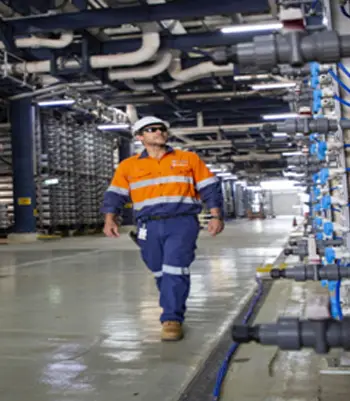
The components of a reverse osmosis plant vary according to the water source, salinity level, required capacity, and target water quality. In general, they can be divided into essential RO components and supporting components installed before or after the system to protect membranes and improve operating efficiency.
Core RO System Components
Pressure vessels and RO membranes: The core part of the system, where water passes through semi-permeable membranes that separate dissolved salts and fine contaminants.
Cartridge or micron filter: Installed before the membranes to remove fine particles that could reduce membrane efficiency or cause clogging.
High-pressure pump: Provides the pressure required to force water through RO membranes. Its type and capacity vary according to the water source and salinity level.
Control panel: Monitors system operation and controls pressure, flow, water quality, and selected performance indicators.
Plant frame or skid: Holds and organizes the RO components safely, particularly in commercial and industrial systems.
Supporting Components
Depending on raw-water characteristics and project needs, an RO plant may also include:
Raw-water tank: Collects water before it enters treatment stages.
Feed pump: Moves water from the source or tank to the pre-treatment stage.
Sand or multi-media filters: Remove sediment and large suspended matter before water enters the RO system.
Activated carbon filter: May be used to reduce chlorine, odors, and some organic materials depending on water type.
Antiscalant or chemical-treatment systems: Help reduce salt deposits and protect RO membranes from clogging or damage.
CIP chemical cleaning system: May be used in larger plants to clean membranes and maintain efficiency.
UV or final disinfection unit: May be added according to the required application and final water quality.
Product-water tank: Stores treated water before distribution or use.
RO plant components are not selected using one fixed configuration for all projects. They are designed according to water analysis, water source, required daily capacity, and intended use. Aqua Sana conducts detailed technical studies to select the appropriate components for each plant, ensuring operating efficiency, membrane protection, and high-quality produced water.
Advantages of Reverse Osmosis
The reverse osmosis systems designed and implemented by Aqua Sana offer operational and economic advantages that make them suitable for a wide range of sectors.
High Contaminant Removal
RO systems do more than reduce total dissolved solids (TDS) to standard levels. They act as an effective barrier against microorganisms, bacteria, viruses, heavy metals such as arsenic and lead, and organic materials. This helps convert raw water from different sources into fresh, clean water with consistent quality.
Lower Long-Term Maintenance Costs
We design our systems for long service life. High-quality equipment significantly reduces the need for frequent maintenance and spare-part replacement. Over time, this investment can generate real operating-cost savings, supported by technical support and after-sales services that help maintain continuous performance.
Lower Energy Consumption Compared with Conventional Desalination
Compared with conventional desalination technologies, such as distillation, reverse osmosis has lower energy consumption. This reduces electricity costs and contributes to longer overall system life, making it a resource-efficient option.
Stable Water Quality
RO technology can remove up to 99% of contaminants, producing treated water with stable physical and chemical properties. The water can be used in industrial production lines, drinking-water applications, irrigation, and agriculture, regardless of the raw feed-water source.
These benefits become more valuable when an RO system is designed based on precise water analysis. Aqua Sana designs reverse osmosis systems according to water characteristics and the needs of each project to achieve the best possible operating efficiency.
Disadvantages and Challenges of Reverse Osmosis
Although reverse osmosis is highly efficient, it requires careful design and operation to avoid certain challenges. Many RO disadvantages are not caused by the technology itself, but by improper system selection or insufficient maintenance.
Main RO Challenges
It requires suitable operating pressure.
It may result in water loss through reject water.
It requires periodic maintenance.
It must be designed according to water type and salinity level.
Energy consumption and input costs can be high.
At Aqua Sana, we help clients reduce these challenges through carefully engineered RO systems that suit water characteristics and operating conditions.
Difference Between Domestic RO Units and Industrial RO Plants
Although domestic RO units and industrial RO plants operate on the same principle, the main difference lies in production capacity and intended use.
Domestic Reverse Osmosis Units
Domestic RO units are commonly used in homes and small-scale applications. They are compact and easy to use.
Industrial RO Plants
Industrial RO plants are designed to provide larger quantities of treated water for factories, hotels, farms, and other facilities. They use larger components, advanced treatment stages, and control systems that support continuous operation and high production capacity.
Aqua Sana designs RO systems according to the intended use and water source to achieve the best performance and operating efficiency for every project.
How to Choose the Right RO System
After understanding what reverse osmosis is and how it works, the next step is choosing the right system according to water characteristics and actual operating requirements. Selecting an unsuitable system may reduce efficiency and increase energy and maintenance costs over time.
Factors to Consider
Water source: well water, seawater, or municipal water.
Salinity and impurity levels.
Daily consumption volume.
Intended application: industrial, agricultural, or commercial.
Available installation space.
Operation and maintenance requirements.
Aqua Sana’s expertise lies in understanding these details and converting them into a practical system that delivers stable water quality and more efficient operation.
Why Choose Aqua Sana?
As a water desalination and treatment specialist, Aqua Sana provides integrated solutions for the Egyptian market, from study and design through operation and follow-up.
Our Advantages
Competitive prices combined with strong implementation quality.
Experience with Egyptian market requirements and different water sources.
Customized solutions for each project.
RO plants for factories, hotels, farms, and industrial sectors.
Carefully selected components to ensure operating efficiency.
After-sales service that supports clients after implementation.
Operation and maintenance solutions for desalination plants.
Repair and refurbishment services for existing plants to improve their efficiency.
After learning what reverse osmosis is, its advantages, challenges, and applications, it is clear that it is one of the most important water treatment and desalination technologies.
However, its success does not depend on the technology alone. It depends on water analysis, understanding project requirements, and selecting the appropriate design according to water source, salinity level, and required water quality.
Working with a specialized company that has technical experience in designing and operating RO systems helps you obtain stable water quality while reducing long-term operating and maintenance problems.
Contact Aqua Sana today for a reverse osmosis system designed according to your water characteristics and project requirements, from technical study through design, implementation, and operation.